
Food & Beverage Insurance provides specialized insurance solutions tailored to businesses across the F&B industry.
What is Food & Beverage Insurance?
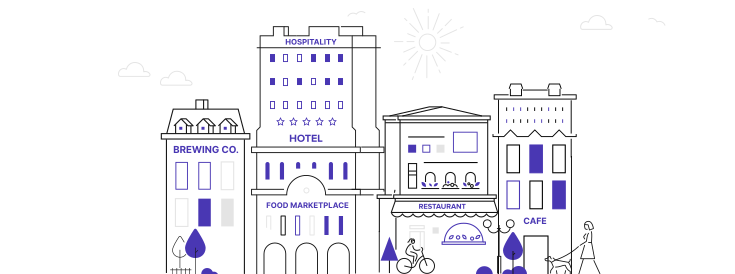
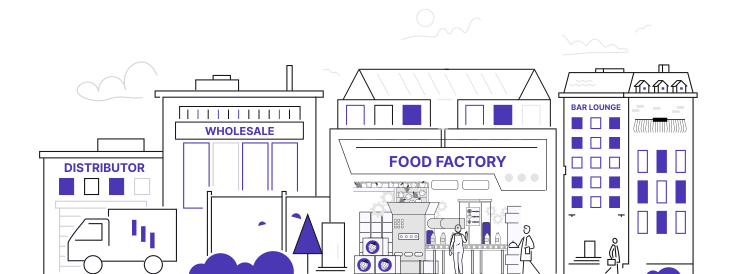
Food & Beverage Insurance provides insurance solutions tailored to businesses across the F&B industry. Whether you operate a restaurant, manufacturing facility, distribution center, or retail brand, we understand the industry’s challenges, from supply chain risks to product liability.
From food contamination coverage to workers compensation and business interruption protection, our programs help businesses mitigate risks and maintain operational resilience. In a sector where safety, compliance, and reputation are critical, we ensure you stay protected—so you can focus on serving customers.
Types of Food & Beverage
Specialized Insurance for the Food & Beverage Industry
- Food Manufacturing
- Beverage Manufacturing
- Confectionery Manufacturers
- Snack Manufacturers
- Wholesale Food Distributors
- Restaurants
- Cafes
- Bar’s
- Supermarkets
- Grocery Stores
- Convenience Shops
- Breweries
- Wineries
- Distilleries
- Catering
- Food Service Businesses
- Food Processing
- Packaging Facilities
- Dairy Producers
- Meat Processors
- Seafood Producers
- Organic & Specialty Food Brands
- Quick Service Restaurants
- Fast Casual Restaurants
- Meal Kit & Subscription Services
- Food & Bev Importers & Exporters
- Beverage Bottling & Distribution
- Food Trucks & Mobile Vendors
- Farm-to-Table Farms
- Sustainable Food Ventures
- Coffee Roasters & Tea Brands
- Commissary Kitchens
- Shared Cooking Spaces
- Functional & Health Food Companies
- Cannabis-Infused Food & Beverage Producers
Types of Coverage
All the Coverage and Service you expect from a Top-Tier risk advisor.
- General Liability
- Product Liability Insurance
- Food Contamination Coverage
- Recall Insurance
- Commercial Property Insurance
- Business Interruption Insurance
- Workers’ Compensation Insurance
- Liquor Liability Insurance
- Cyber Liability Insurance
- Equipment Breakdown Insurance
- Auto Liability & Fleet Insurance
- Errors & Omissions (E&O)
- Directors & Officers (D&O)
- Umbrella & Excess Liability
- Supply Chain Insurance
- Spoilage Insurance
- Environmental Liability
- Key Person Insurance
- Crime & Fraud Insurance
- Regulatory & Compliance Liability Coverage
- Inland Marine Insurance (for mobile & transported goods)
- Food-Borne Illness & Food Safety Coverage
- Employment Practices Liability Insurance (EPLI)

Food and Beverage Manufacturing Insurance: Coverage, Limits and Costs
Food and beverage manufacturers spend 1.0% to 2.1% of revenue on a full insurance program, more than general manufacturing, because contamination and recall are severity exposures. A $10 million food manufacturer pays $95,000 to $410,000 a year depending on product category, plus $8,000 to $45,000 for standalone recall. Product category moves the number more than revenue does.
The FDA logged 251 food and beverage recall events in 2025, about five a week. Undeclared allergens caused 115 of them, more than pathogens at 94. The most common reason food gets recalled in the United States is a labelling error, not a bug.

The seven risks that define food manufacturing

1. Contamination.
Biological, chemical, physical or radiological. Pathogens drove 94 of the 251 FDA recall events in 2025. Environmental monitoring finds most contamination before a consumer does, good news for public health, expensive news for your P&L, because a positive swab triggers a hold and a recall with no injured party to make a liability claim.
2. Allergen mislabelling.
The largest single recall cause in the US. The Big 9 allergens are milk, eggs, fish, crustacean shellfish, tree nuts, peanuts, wheat, soybeans and sesame, the last added by the FASTER Act with requirements effective 1 January 2023. Milk and dairy accounted for roughly 30% of allergen recalls in 2025. Most trace to a packaging change, a supplier reformulation or a line changeover.
3. Spoilage and refrigeration breakdown.
A compressor fails on a Friday night. You lose the stock and the production window. Standard property forms exclude mechanical breakdown outright, so without equipment breakdown coverage the compressor and everything it was cooling are both uninsured.
4. Recall.
Separate policy, separate underwriting, separate limits. A package sublimit is not a recall program. What a real policy pays sits on product recall insurance.
5. Foreign object contamination.
Metal, plastic, glass, bone. Detectable, preventable, and a leading cause of USDA FSIS recalls. Your metal detection and X-ray validation records are an underwriting document.
6. Supply chain and ingredient liability.
You are responsible for what your supplier sent you. The 2009 Peanut Corporation of America contamination forced recalls at more than 360 downstream companies who had done nothing wrong. Under FSMA, supplier verification is a required program element.
7. Equipment breakdown.
Fillers, retorts, ovens, blast freezers, pasteurisers, CIP systems. Production stops the moment one fails.
What coverage a food manufacturer needs, and typical limits
| Coverage | Why food specifically | Limit guidance |
|---|---|---|
| General liability with products | Foodborne illness claims, premises exposure | $1M/$2M/$2M, umbrella above |
| Product liability | Illness, injury, foreign object claims | $2M – $10M by customer requirement |
| Product recall and contamination | Largest severity exposure in the segment | $1M – $5M standalone. A package sublimit is not coverage. |
| Commercial property | Building, plant, stock at peak inventory | Replacement cost; watch seasonal peaks |
| Spoilage and refrigeration breakdown | Stock loss when temperature control fails | Schedule real stock value, not a token sublimit |
| Equipment breakdown | The peril your property policy excludes | Match to your object schedule |
| Business income | Lost gross earnings during shutdown | 12–18 months; check the coinsurance percentage |
| Contingent business interruption | Single-source ingredient or single-customer failure | Schedule critical suppliers by name |
| Workers’ compensation | Cuts, burns, repetitive strain, cold, ammonia | Statutory + $1M employers’ liability |
| Commercial auto | Delivery fleet, refrigerated transport | $1M CSL |
| Cyber | Production control systems, order and traceability data | $1M – $5M |
Need Food & Beverage Insurance for your Business?
Get a customized risk assessment from one of our experienced insurance risk advisors now. Book a time here.
Get a quote
Typical limits food manufacturers carry, by revenue band
The ISO occurrence form, CG 00 01 04 13, carries two separate aggregates: a General Aggregate for premises and operations, and a Products-Completed Operations Aggregate for everything that leaves your dock. A foodborne illness cluster erodes the products aggregate and leaves the general aggregate untouched. The products figure is the one that matters on this class.
| Annual revenue | Per occurrence | General aggregate | Products-completed operations aggregate | Umbrella | Standalone recall |
|---|---|---|---|---|---|
| $1M – $5M | $1M | $2M | $2M | $1M – $2M | $0M |
| $5M – $10M | $1M | $2M | $2M | $2M – $5M | $1M – $2M |
| $10M – $25M | $1M | $2M | $2M | $5M | $1M – $2M |
| $25M – $50M | $1M | $2M | $4M | $5M – $10M | $2M – $5M |
| $50M+ | $1M | $2M | $2M | $10M+ | $5M+ |
Customer contracts drive the umbrella column more than exposure does: a national grocer routinely requires $5 million total limits from a $6 million supplier. Ready-to-eat processors should read one band up.
Exclusions and coverage gaps in a food manufacturing program
CG 00 01 provides zero first-party recall coverage. Exclusion (n) bars “any loss, cost or expense incurred by the insured or others for the loss of use, withdrawal, recall, inspection, repair, replacement, adjustment, removal or disposal” of your product where it is withdrawn because of a known or suspected defect. Exclusion (k) removes damage to your own product. Exclusion (m) bars pure economic-loss claims where nothing but your product was physically injured. The customer who lost three days of production to your off-spec ingredient has no covered claim. Illness claims are covered. Pulling the pallets back is not. That is the line product liability insurance and a recall policy divide between them.
Then four gaps, in the order we find them.
Allergen mislabelling. Not every recall form covers it. Some accidental contamination agreements are drafted around microbiological and chemical contamination and treat a labelling error as a quality problem. If your form does not name allergen mislabelling, assume it is excluded.
Contingent business interruption on a single-source ingredient. Most food manufacturers have at least one ingredient with exactly one qualified supplier. When that supplier goes down you stop, and your property policy pays nothing because nothing of yours was damaged. ISO CP 15 08 applies your full business income limit to a dependent property loss; CP 15 09 requires a separate scheduled limit. Either way it has to be bought and the suppliers scheduled. Abbott’s Sturgis plant closed roughly three and a half months in 2022 and took 21% of the national infant formula supply off shelves.
Third-party recall costs. Your ingredient goes into someone else’s finished product. They recall it and bill you. Your first-party coverage does not respond, because they are not your costs. Ingredient suppliers need third-party recall specifically.
Spoilage sublimits set years ago. A $100,000 sublimit written when you had one cooler is not adequate now that you have three and a blast freezer.
The three contamination insuring agreements
Contamination coverage is three insuring agreements bundled under one heading, and manufacturers find out which ones they bought at the worst possible moment.
Accidental contamination.
The workhorse. It responds when your product is unintentionally contaminated (microbiological, chemical, physical or, in a well-written form, allergenic) during production, packaging, storage or transit. Some forms require that consumption would cause bodily injury, a reasonable-belief standard. Others require that it has. That word decides whether you are covered for the positive environmental swab that stops your line before a consumer is affected, which is how most real contamination events are found. Chubb’s materials confirm the coverage “does not require the insured’s product to have caused actual bodily injury or property damage,” but food and consumable forms are the most likely to narrow it.
Malicious product tampering.
Deliberate contamination by a third party: extortion, employee sabotage, or adulteration at retail. Sabotage is where the “acts of the insured” exclusion becomes live. A good form separates the company’s acts from a rogue employee’s. 21 CFR Part 121 requires covered facilities to run a vulnerability assessment, identify actionable process steps and implement mitigation strategies. Underwriters ask for it.
Government-mandated recall.
Responds when FDA, USDA FSIS, CPSC or NHTSA orders or requests a recall. That second word carries the agreement. Most FDA food recalls are technically voluntary, conducted under agency pressure after an inspection finding or a Reportable Food Registry submission. A form answering only a formal mandatory order leaves you uncovered for the recall you actually conduct.
The allergen mislabelling wording check
Read your recall or contaminated products form for the words “allergen” and “mislabelling.” If neither appears, ask the carrier in writing whether an undeclared allergen recall is covered, and keep the answer on file. Most allergen recalls trace to a packaging changeover, an unflagged supplier reformulation, or a line changeover without validated cleaning. All controllable, all documented, all things underwriters credit if you show them.
How much food manufacturing insurance costs
Nobody publishes food-specific pricing. Premiums in this segment move more year to year than almost any other manufacturing class, so here is something to benchmark against.
Where the money goes
| Coverage | Share of total program | Rating basis |
|---|---|---|
| Workers’ compensation | 20% – 35% | Payroll per $100, by class code |
| Commercial property (incl. spoilage) | 15% – 25% | Total insured value per $100 |
| General liability with products | 12% – 20% | Gross sales per $1,000 |
| Business income and extra expense | 8% – 14% | Annual gross earnings |
| Equipment breakdown | 4% – 8% | Object schedule |
| Commercial auto | 4% – 10% | Per vehicle and driver |
| Umbrella and excess | 5% – 10% | % of underlying |
| Cyber | 2% – 5% | Revenue and controls |
Total annual program by revenue band
| Annual revenue | Shelf-stable / dry goods | Refrigerated / frozen | Ready-to-eat / RTE meat |
|---|---|---|---|
| $1M – $5M | $18,000 – $52,000 | $24,000 – $68,000 | $32,000 – $88,000 |
| $5M – $10M | $50,000 – $110,000 | $65,000 – $148,000 | $85,000 – $195,000 |
| $10M – $25M | $95,000 – $235,000 | $125,000 – $310,000 | $160,000 – $410,000 |
| $25M – $50M | $190,000 – $470,000 | $250,000 – $630,000 | $330,000 – $820,000 |
| $50M+ | Priced individually | Priced individually | Priced individually |
For comparison against machine shops, plastics and metal fabrication, see how much manufacturing insurance costs.
Cost by product category
Hazard follows the kill step. If there is a cooking or pasteurisation step between your plant and the consumer’s mouth, your rate drops. If there is not, every control in your facility is a critical one and your rate reflects it.
| Category | Relative products and recall loading | Why |
|---|---|---|
| Shelf-stable dry goods, grain, flour | Baseline | Low water activity, long shelf life, consumer kill step common |
| Canned and retorted | Baseline to +15% | Validated kill step, but C. botulinum severity if it fails |
| Beverage, non-alcoholic | +10% to +30% | Carbonation and pressure, labelling accuracy, high unit counts |
| Snack and confectionery | +15% to +40% | Allergen cross-contact on shared lines, seasonal peaks |
| Bakery | +20% to +45% | Allergen density, oven and proofer breakdown, dust |
| Dairy | +40% to +80% | Refrigeration dependency, Listeria, high spoilage values |
| Frozen and refrigerated | +45% to +90% | Cold chain dependency, spoilage, breakdown correlation |
| Fresh-cut produce | +60% to +110% | No kill step, short shelf life, pathogen history |
| Ready-to-eat and RTE meat | +80% to +150% | No consumer kill step, USDA jurisdiction, Listeria severity |
| Supplements and nutraceuticals | +100% to +250% | Claims substantiation, adulteration, limited carrier appetite |
| Pet food | +30% to +70% | Separate regulation, rapid consumer amplification, brand exposure |
Get tailored coverage for your business now.
Speak to an agent that actually cares about your business today.
Get a quote
Product liability and recall pricing for food
Every prospect who sends us a declarations page gets one back marked up. Five problems recur.
Products liability is rated per $1,000 of gross sales. ISO manufacturing and processing classifications fall in the 50000–59999 range, and higher sales volume generally produces a lower rate per $1,000. Indicative food rates run $3.00 to $9.00 per $1,000 for shelf-stable and canned, $8.00 to $18.00 for refrigerated and frozen, and $15.00 to $35.00 for ready-to-eat and supplements. [VERIFY AGAINST OUR BOOK]
Recall pricing follows annual sales, product category, distribution footprint, traceability and loss history.
| Standalone recall limit | Indicative annual premium, $10M food manufacturer |
|---|---|
| $1M | $8,000 – $18,000 |
| $2M | $13,000 – $28,000 |
| $5M | $25,000 – $52,000 |
| $10M | $45,000 – $95,000 |
The sublimit question. Most food manufacturers who think they have recall coverage have a $25,000 to $100,000 sublimit inside a package policy, labelled “product withdrawal expense.” Set that against the FMI and GMA industry study figure of $10 million in average direct recall cost (a pre-2015 study, so read it as a floor) or J.M. Smucker’s own estimate of roughly $125 million for the 2022 Jif recall. The sublimit is a crisis-PR budget.
Requires a certificate of liability insurance with minimum $25,000 bodily injury coverage and $25,000 property damage coverage—notably lower than most states with comprehensive programs.
Property, spoilage and refrigeration breakdown costs
Food manufacturers underinsure stock more consistently than any other segment: inventory peaks, and spoilage sublimits nobody has revisited.
Refrigeration breakdown.
The ISO Causes of Loss Special Form (CP 10 30 09 17) excludes “mechanical breakdown, including rupture or bursting caused by centrifugal force.” Equipment breakdown adds it back, and it is the coverage that also pays for the stock the compressor was cooling, the resulting business income and expediting expense.
Off-premises power failure.
Check whether spoilage responds when the utility fails rather than your own equipment. It frequently does not by default, and utility interruption is the more common cause.
The waiting period.
Some spoilage forms apply a deductible measured in hours of outage rather than dollars.
Peak season endorsements.
If inventory doubles for a quarter, a flat annual limit leaves you underinsured for three months and overinsured for nine.
For manufacturers, business income runs on gross earnings, the sales value of production less the cost of the raw stock it came from. Value added, not sales minus cost of goods sold. Coinsurance is a function of time: months to restore divided by twelve. If a retort is a nine-month lead item, 50% is not enough.
Workers’ compensation in food manufacturing: NCCI class codes 2003, 2095 and 2065
Usually the largest line, at 30% to 45% of the program.
Class codes. NCCI 2003 bakery. 2095 meat products manufacturing, facilities that handle and process meat but do not slaughter livestock. 2065 milk products manufacturing NOC. 2121 brewery and drivers, including distributing stations. Fruit and vegetable canning classifies by state: California’s WCIRB uses “Fruit or Vegetable Preserving including Canning,” Delaware uses code 0113. NCCI 2143 is Winery & Drivers, not a general canning code, a common and expensive misclassification.
NCCI sorts codes into hazard groups A through G, A carrying the lowest severity potential, but the code-to-letter mapping is not public. Neither is any rate-per-$100-of-payroll table by class code and state; those are bureau filings.
Eleven states run their own bureaus rather than NCCI: California, Delaware, Indiana, Massachusetts, Michigan, Minnesota, New Jersey, New York, North Carolina, Pennsylvania, Wisconsin. Four run monopolistic funds: North Dakota, Ohio, Washington, Wyoming. Texas is not an independent-bureau state. It uses NCCI loss costs, and it is the only state where workers’ compensation is optional for private employers.
What drives the rate. Lacerations from slicing and portioning equipment, burns from ovens and fryers, repetitive strain, wet floors, cold stress in freezer operations, ammonia exposure. Manufacturing accounts for roughly half of the 26,000-plus amputations recorded in the US between 2015 and 2024, and meat and poultry processing sits at the top of that distribution.
Your mod multiplies all of it. A 1.25 experience modification rate on a $180,000 workers’ compensation line costs $45,000 a year more than a 1.00. Medical-only claims are discounted to 30% of value before entering the calculation, and the experience period runs three years with a one-year lag. A bad 2024 is still in your 2027 mod. Experience modification rate for manufacturers covers how to bring it down.
Worked example: $15M refrigerated foods manufacturer
Single facility, 68 employees, $4.1 million payroll, SQF certified, no Class I recall in five years, sprinklered masonry building, six-vehicle refrigerated fleet.
| Line | Basis | Annual premium |
|---|---|---|
| Workers’ compensation | $4.1M payroll, mod 0.94 | $71,400 |
| Commercial property | $9.8M building, equipment and stock at peak | $38,600 |
| Spoilage and refrigeration breakdown | $1.2M stock sublimit | (included in property) |
| Equipment breakdown | Scheduled compressors, chillers, fillers, boiler | $11,900 |
| General liability with products | $15M gross sales | $26,300 |
| Business income and extra expense | 12 months gross earnings, agreed value | $22,700 |
| Commercial auto | 6 refrigerated vehicles | $28,400 |
| Umbrella | $5M over primary | $18,200 |
| Cyber | $2M limit | $6,800 |
| Subtotal, core program | $224,300 | |
| Product recall (standalone) | $2M limit, $50,000 retention | $21,500 |
| Total | $245,800 | |
| As % of revenue | 1.64% |
Workers’ compensation and property together are 45% of that program. Products and recall, which get all the attention in food, are 19% combined.
What SQF, BRCGS, FSSC 22000 and HACCP certification are actually worth
No carrier files a published rate credit for food safety certification. Unlike a sprinkler credit in property, which is filed with the state and published, GFSI certification enters pricing through underwriter judgment. Anyone quoting you “SQF saves 8%” is inventing it.
What certification buys, in order of value:
1. Market access.
Several recall and contamination underwriters will not quote an uncertified facility at all. The credit is not a discount. It is the difference between three quotes and none.
2. Better recall terms.
Lower self-insured retentions, broader trigger wording, fewer conditions. On a $5 million recall placement, moving the retention from $100,000 to $25,000 beats any percentage discount.
3. Fewer policy conditions.
Uncertified facilities often get recall coverage subject to conditions precedent: maintain traceability, run annual mock recalls, notify within 24 hours. Certified facilities get the same coverage without them, which matters at claim time.
What underwriters score:
- Scheme and grade. BRCGS grades AA through D; an AA carries weight, a C invites questions. SQF is owned by the SQF Institute, a division of FMI. FSSC 22000 is built on ISO 22000 by the Foundation for Food Safety Certification. IFS dominates continental European retail.
- Audit score and open corrective actions.
- Mock recall trace times. Two-hour lot tracking materially improves terms; four hours is the common benchmark.
- Environmental monitoring, with 12 months of trend data and documented corrective action on positives.
- Allergen control plan and changeover validation. With allergens causing 115 of 251 FDA recalls in 2025, this is a primary underwriting question now.
- Approved supplier program and certificates of analysis.
Certification costs real money: audit fees $5,000 to $20,000, consulting and training $3,000 to $50,000, three to six months with an existing food safety system and six to twelve from scratch. Whether that pays for itself in premium alone is a genuine question. In market access, customer requirements and recall terms, it is not. And if your broker has not put the certificate, the audit score and your mock recall times in front of the underwriter, you are paying for something you are not using.
What FSMA requires: 21 CFR 117.126(b) and the written recall plan
Covered non-exempt facilities must prepare, or have prepared, and implement a written food safety plan overseen by a Preventive Controls Qualified Individual (§117.126(a)). Section 117.126(b) lists what it must contain: a written hazard analysis, preventive controls, a supply-chain program, a recall plan, monitoring, corrective actions and verification.
The recall plan is a legal requirement, not an underwriting preference, and the hazard analysis must be documented even where it identifies no preventive control. Facilities under the Qualified Facility threshold (average annual sales below roughly $1.41 million on FDA’s inflation-adjusted table) have modified requirements but should still document. HACCP is mandatory in its own right for seafood (21 CFR 123), juice (21 CFR 120), and meat and poultry under USDA FSIS (9 CFR 417).
Coverage by sub-segment
Bakery.
Oven and proofer breakdown, flour dust explosion exposure, allergen management across wheat, egg, dairy, soy and tree nuts on shared lines. NCCI 2003.
Dairy.
Refrigeration dependency, pasteurisation as a critical control point, high spoilage values, ammonia systems with their own process safety exposure. NCCI 2065.
Meat and poultry.
USDA FSIS jurisdiction and continuous inspection rather than FDA. High workers’ compensation severity. RTE meat rates at the top of the food products liability range. NCCI 2095 where there is no slaughtering.
Beverage.
Carbonation and pressure vessels, ABV labelling accuracy, can and bottle integrity. Over-carbonation recalls are a documented pattern. FDA recalled Wisco Pop! soda over potential over-carbonation and can rupture. Craft beer has its own program and class code: craft brewery and beverage manufacturing insurance.
Snack and confectionery.
Allergen cross-contact on shared lines, seasonal peaks that break a flat property limit, foreign object risk from nut handling.
Ready-to-eat.
The highest-rated category in the segment. No consumer kill step means every control is a critical one.
Supplements and nutraceuticals.
A liability profile closer to pharmaceutical than food. Claims substantiation, ingredient sourcing and adulteration drive the rate.
Pet food.
Separately regulated, with a consumer base that reacts faster and louder than any other category. Brand rehabilitation coverage matters more here than almost anywhere.
Carrier appetite and underwriting requirements for food manufacturers
Appetite sorts on three questions: is there a consumer kill step, is the facility GFSI certified, and has there been a Class I recall in five years. Certified shelf-stable dry goods with clean loss history is a standard middle-market risk with a dozen carriers competing. Ready-to-eat, fresh-cut produce and RTE meat narrow to specialist food practices. Supplements sit largely in excess and surplus lines. The same risk sees a wide premium spread between a specialist and a generalist carrier, so the submission decides more than the exposure does.
- Five years of currently valued loss runs, all lines
- Product list with sales split by category, RTE percentage stated separately
- Distribution profile: retail, foodservice, private label, export percentage, largest customer concentration
- Written food safety plan and hazard analysis, with the PCQI named
- GFSI certificate, audit score and open corrective actions
- Recall and withdrawal history, including withdrawals that never became recalls
- Mock recall results with documented trace times
- Environmental monitoring program and 12 months of trend data
- Approved supplier program and certificates of analysis
- Allergen control plan and changeover validation procedures
- Food defense vulnerability assessment under 21 CFR Part 121
- Property schedule with construction, sprinkler status, refrigeration and peak stock values
- Payroll by workers’ compensation class code
- Customer insurance requirements from your largest accounts
Frequently asked questions
What is a typical products-completed operations aggregate for a food manufacturer?
$2 million on the primary at most revenue bands, alongside a separate $2 million general aggregate on CG 00 01. Manufacturers above $25 million in sales commonly carry $4 million. Ready-to-eat processors buy the aggregate of a company one band larger, with $5 million to $25 million of umbrella above.
What are standard product recall limits by food category?
$1 million to $2 million for shelf-stable dry goods, $2 million to $5 million for refrigerated, frozen and dairy, and $5 million to $10 million for ready-to-eat, RTE meat and fresh-cut produce. Chubb caps primary consumable capacity at $2 million, so anything above that is a layered tower.
Does food manufacturing insurance cover allergen mislabelling?
Only if the recall or contaminated products form names allergen mislabelling, or defines contamination broadly enough to include it. Forms drafted around microbiological, chemical and physical contamination can treat a labelling error as a quality failure. Allergens caused 115 of 251 FDA recalls in 2025. Confirm it in writing.
What triggers accidental contamination coverage?
Unintentional contamination of your product during production, packaging, storage or transit. The wording that matters is whether consumption would cause bodily injury or has caused it. A reasonable-belief trigger covers the positive environmental swab that stops your line; an actual-injury trigger does not.
What NCCI class codes apply to food manufacturing?
NCCI 2003 bakery, 2095 meat products manufacturing where no livestock is slaughtered, 2065 milk products manufacturing NOC, 2121 brewery and drivers. Fruit and vegetable canning is state-specific. California uses a WCIRB preserving and canning class, Delaware code 0113. NCCI 2143 is winery, not general canning.
What does FSMA require of a food manufacturer?
Under 21 CFR 117.126, a covered facility must implement a written food safety plan overseen by a PCQI. Section 117.126(b) requires a documented hazard analysis, preventive controls, a supply-chain program, a recall plan, monitoring, corrective actions and verification. The recall plan is a legal requirement, not an underwriting preference.
Which carriers have appetite for ready-to-eat and supplement manufacturers?
Ready-to-eat and RTE meat narrow to specialist food practices willing to underwrite a no-kill-step process, and GFSI certification is usually a precondition to quoting. Supplements and nutraceuticals sit largely in excess and surplus lines on claims substantiation and adulteration exposure; several standard food markets decline them outright.
What insurance do food manufacturers need?
General liability with products, product recall and contamination, commercial property with spoilage, equipment breakdown, business income with contingent business interruption, workers’ compensation, commercial auto and cyber. Recall is the coverage most frequently missing and the one with the highest severity.
Does product liability cover food contamination?
It covers third-party claims from people made ill by your product. It does not cover the cost of pulling product back. Exclusion (n) in the standard general liability form removes withdrawal, recall, inspection, replacement and disposal costs entirely. That needs a separate recall policy.
How much does food manufacturing insurance cost?
Roughly 1.0% to 2.1% of revenue. A $10 million manufacturer runs $95,000 to $235,000 shelf-stable, $125,000 to $310,000 refrigerated, and $160,000 to $410,000 ready-to-eat, plus $8,000 to $45,000 for standalone recall depending on limit.
What does spoilage coverage actually pay?
The value of stock lost when temperature control fails, subject to a stated sublimit and usually requiring a covered breakdown or power interruption as the cause. Check the sublimit against peak stock, whether off-premises power failure is included, and whether the deductible runs in hours rather than dollars.
Does GFSI certification lower my insurance premium?
No carrier files a published rate credit for SQF, BRCGS, FSSC 22000 or HACCP certification. What it buys is market access, lower recall retentions, broader trigger wording and fewer conditions precedent. On a $5 million recall placement, cutting the retention from $100,000 to $25,000 beats any percentage discount.
What is contingent business interruption?
Coverage for your lost income when a supplier or customer suffers a loss that shuts you down, even though nothing of yours was damaged. ISO CP 15 08 applies your full business income limit; CP 15 09 requires a separate scheduled limit. Suppliers generally need naming on a schedule.
Yes, and the exposure is operational rather than reputational. A ransomware event that locks a production control system stops shipping, and the business interruption loss dwarfs the ransom. Manufacturing is among the most-targeted sectors, and most carry limits set before their plant floor was networked.
Get food manufacturing insurance from Alliance Risk
Food manufacturing insurance isn’t one policy. It’s a program built for severity, because one contamination event does more damage than a decade of ordinary claims. And the failures are consistent: a recall sublimit that wouldn’t cover the freight, a contamination form that never mentions allergen mislabelling, and no contingent business interruption on the one ingredient with a single qualified supplier.
Coverage is half of it. The other half is what your customers and your underwriters both look at: a written food safety plan with a named PCQI, environmental monitoring with real trend data, allergen changeover validation, and mock recalls with the times recorded. Insurance pays for the recall. Your food safety program decides whether you have one, and what a carrier will charge you for the risk.
We place food and beverage manufacturing across specialty and surplus lines markets, and we put your certification in front of underwriters properly. If you’re SQF or BRCGS certified and nobody has shown the market your audit score and your mock recall times, you are paying for something you aren’t using.
Send us your declarations page, your GFSI certificate and your last mock recall result. We’ll tell you what your recall sublimit would actually cover, whether allergen mislabelling is named in your form, and which suppliers belong on a contingent business interruption schedule.
Talk to us about your food manufacturing program →
Part of the full manufacturing insurance program.

Talk to a Risk Advisor today.
Click below to share more about your business and schedule a time that works for you.
Why Us?

Risk Advisory Team
Insurance experts who specialize in your industry.

Digital Platform
Online access to your insurance program.

Customized Products
Tailored insurance solutions with A-rated carriers.

Exceptional Support
Your first call for all insurance needs, 24/7.

Exclusive Savings
Minimized risk costs, saving clients thousands yearly.
Protecting Your Passion with Food & Beverage Insurance
Food & Beverage Insurance navigates the complexities of the food industry with tailored insurance solutions. Whether you’re manufacturing, distributing, or serving, we ensure you’re protected so you can focus on delivering quality and innovation.